
Australia’s land area is a little smaller than the United States, and its stunning variety of landscapes, from endless coastal drives to iconic red outback deserts, makes it an exceptional country for a self-drive holiday.
In fact, “The Big Lap” (Australia’s Highway 1), which joins all major cities in a 15,000km loop, can take anywhere from a few weeks to over a year to complete, depending on your pace and planned activities. Thousands of Americans visit Australia each year to experience the famous Aussie sights, and it was within the top 3 of visitor arrivals in 2025 (Tourism Australia).
The good news for American tourists looking to road trip here is that Australian rental cars include insurance; you don’t need to organise your own like in the US. The slightly less good news is that Australians drive on the left-hand side of the road, but don’t fear, you get used to it pretty quickly.
We have over 35 years in the car rental game and are now Australia’s largest family-run car rental company, so we have a lot of advice to share for any Americans thinking of renting and driving here, including:
- The rules for renting in Australia
- US driver’s licence rules
- The difference in road rules
- Parking signs
- Toll roads
- City vs Outback driving
- Aussie tips
- FAQs
TL:DR Driving Tips for US Drivers in Australia
- Drive on the left. If you’re worried, just remember that on major highways, we have huge signs warning tourists not to turn the wrong way, so you are always reminded.
- Expect an automatic transmission.
- Check the speed limit per state.
- Children under 7 must be in a car seat or booster seat.
- Seat belts are mandatory.
- Drivers cannot use mobile phones.
- There are many toll roads across Australia.
- Load up on fuel at every stop if you are driving in the outback.
- Expect kangaroos, wallabies or wombats on the road, especially at dawn and dusk in remote areas.
- Never swerve to avoid wildlife. Instead, beep your horn and brake if it is safe to do so.
What are the rules for renting a car in Australia?
Renting a car in Australia is highly accessible, with rental car options at every major city and most rural airports. Here’s everything you should know so there are no bumps in the road:
- Minimum age: Most car rental companies in Australia have a minimum driver age of 25, with some offering car rentals for drivers 21 and over. In the US, the usual standard is 21, with some states offering rentals to drivers as young as 18. Redspot is one of the few companies to have a minimum age policy of 21 in Australia, and we welcome young American drivers! Those under 25 will pay a daily surcharge on their car rental fee, included on the invoice, and will have a choice of medium-sized sedans and hatchbacks.
- Maximum age: Like in the States, the Australian government does not impose a standardised maximum age limit for car rentals, but some companies may impose their own upper limit. All car rental companies require senior drivers to have a full, valid licence, and some may ask for a recent doctor’s certification.
At Redspot, age is just a number. We have no upper limit and only require a full, valid driver’s licence. - Credit card: You will need to carry your physical credit card to hire a car in Australia; most companies cannot accept a digital card to take your deposit.
- Licence: A fully valid US driver’s licence, written in English, is required to rent a car in Australia. Although digital versions are available in the US, you will still need to carry your physical card to show at pick up in Australia.
- Additional proof of ID: Some car rental companies will require you to bring an additional document with proof of your address, so it’s always best to bring this with you on your trip. These documents include utility bills, bank or credit card statements and driver’s licences.
- Insurance: Unlike in the US, Australia has a government mandate for all car rental companies to have basic insurance included in the price of your rental car. This covers you for third-party liability and damage loss waiver (subject to an excess amount), whereas the United States does not include any cover as standard.
- Fuel tank: Generally, you will pick up your hire car with a full tank of petrol (gas) or a full battery and must return it in the same condition. For ease, Redspot offers refueling services for pre-paid fuel. Meaning, you don’t have to worry about finding a servo stop on your way back to the branch.
- Pick up: Usual pick-up times fall within business hours, with extended opening hours for airport locations. Many Redspot branches offer out-of-hours pick-up services to accommodate your desired rental time.
- Drop off: You will need to clean your rental car of any rubbish and personal belongings before dropping off. Some car rental companies, like Redspot, offer an out-of-office drop-off box at many branches so you can return at any time.
- Airport shuttle bus: In Australia, many car rental companies may have “off-airport locations” in which you will be picked up in a shuttle bus and taken to the car hire branch. Redspot proudly has many airport branches within the airport, so you can easily go from luggage to key collection.
- One-way rentals: Like the US, Australia is a large country, and it takes longer than you may think to drive between states or cities. Many car hire companies offer one-way rentals so you can maximise your trip without circling back. In some cases, a one-way car rental fee may be added to your rental quote to account for the time needed to return your car to its original branch. In some remote outback locations, like in the Northern Territory and Western Australia, one-way rentals may not be available as it’s harder to restock cars in these locations.
Will I be charged in USD or AUD for a hire car in Australia?
You will be charged AUD for your hire car, even if you book from the United States. This includes booking a car hire directly from the branch. Use a currency converter to view your quote in USD and gain a comprehensive overview of your hiring costs.
Renting a car in Australia with a US license
American drivers can generally rent and drive in Australia using a full, valid US driver’s licence and must ensure the licence is valid for the full duration of the trip. As US licences are in English, it is not mandatory to carry a translation or an international driver’s permit. The physical driver’s licence must be carried at all times, as a digital licence may not be accepted. US learner and provisional licence holders are not permitted to drive in Australia.
It’s essential to note that some driver’s licence rules differ from state to state, so it’s always beneficial to research the regulations before travelling interstate.
Country-wide rules:
- You do not need an International Driving Permit (IDP) to drive in Australia, as US licences are accepted.
- Your US driver’s licence should be in English.
- Your licence must be a current and valid licence (i.e. not expired or suspended).
- Typically, you must carry your physical driver’s licence with you.
How long can you drive on a US licence in Australia?
Visitors and those on a temporary visa can generally drive in Australia using a US licence, as long as it remains valid for the full duration of the visit. US permanent visa holders or those who plan to stay indefinitely must convert to an Australian licence within 3 months if residing in the Northern Territory, and 6 months in every other state. It’s important to check each state’s rules before planning to drive in Australia.
Different road rules in the US vs Australia
Australia and the US have a lot of similarities, both operate with a state-by-state rule system, strict drink driving rules and restrictions on phone usage. However, there are a few differences to be aware of before driving in Australia.
In general, the key differences are:
| Rule | US | Australia | Notes on Similarities and Differences |
| Driving Side | Drive on the right side of the road; the driver sits on the left side of the car. | Drive on the left side of the road; the driver sits on the right side of the car. | American drivers must familiarise themselves with the rules of driving on the left-hand side of the road. |
| Speed Limits | Highways/freeways: Signposted in mph and range 65-80 mph (105 – 130 km/h) | Highways/freeways: Signposted in km/h and are typically 100-110 km/h (62-68 mph) | Speed limits in Australia differ by units and can be lower than major highways in the US. |
| Urban areas: Depends on the state or city but can range between 25-35 mph (40-56 km/h) | Urban areas: Usually 50 km/h, sometimes 40 km/h zones (24-31 mph). | Urban limits are in a similar range in Australia. | |
| Alcohol Limits | Full licence: 0.08% BAC | Full licence: 0.05% BAC for full licence holders | Australia has a lower general blood alcohol limit (BAC) limit for full licence holders. |
| Young drivers: 0.01% or zero tolerance for those under 21. | Learner: Strict zero tolerance for learner and provisional drivers. | Both have strict 0% alcohol restrictions for young or learner drivers. | |
| Alcohol Testing | Sobriety checkpoints can occur in some states. | Australian police regularly conduct random breath testing (RBT), and drivers may be stopped at any time. | The BAC limit can be tested at any time in Australia. |
| Licensing System | Licence rules are decided state by state, but generally follow a 3-phase graduate system.1. Learner’s permit.2. Intermediate/provisional stage3 . Full licence.The whole process could take several months depending on a driver’s age and the state’s mandated periods. | 1. Learner licences must complete a theory test and log a set amount of driving practice hours (differs per state).2. Must pass a practical test to progress to a P1 provisional licence.3. After around 12 months, drivers move to a P2 licence.4. After around 2 years, drivers can progress to a full licence.It could take anywhere between 2 and 4 years to progress to a full licence, depending on the state rules. | Both have graduated systems, but Australia explicitly subdivides provisional stages with driver restrictions for each stage. It generally takes longer for an Australian driver to receive a full licence compared to a US driver. |
| P Plates use | P plates are mandatory in only some states. | Drivers on P1 provisional licences must display Red P plates, then Green P plates for P2 provisional licences. | Australia uses two levels of P plates with different restrictions. |
| Speed Cameras | The use of speed cameras is decided state by state; some use them frequently, and some restrict them to only school zones or prohibit them completely. | Speed cameras usually have warning signs, and most states require signposts. | Expect speed cameras across Australia. |
| Roundabouts | Less common in the US and rules vary state by state. | Common and smaller. Priority is given to traffic already on the roundabout. | Roundabouts are used in both, but have some priority rule differences. |
| Road Signs | Imperial metric signage and follow a MUTCD standard for shapes, colours and symbols. | A mix of metric signage (km for speed), MUTCD standard and some unique Australian variants. | Both use similar shapes and colours for road signs. Speed signs will differ, and there will be variants in warnings (e.g., wildlife warning). |
| Road Markings | Similar white and yellow lines to separate traffic lanes, but the road markings for parking, turning lanes etc can vary state by state. | White lines separate traffic lanes; yellow lines indicate no stopping. | Similar colour coding, but precise meanings of lines can vary by state in both Australia and the US. |
| Turn on red | A right turn on a red light is widely accepted unless signposted otherwise. | A left turn on red is generally not allowed unless specifically signposted. | Australia generally does not allow a turn on a red light, always follow the signposts. |
| Mobile Phone Use | Hands-free only while driving. | Hands-free only while driving, strict fines for handheld.Fines differ per state but can reach over $1,000 in Queensland. | Similar strict regulations on mobile phone use while driving. |
| Seat Belt Laws | Mandatory for drivers and passengers. | Mandatory for drivers and passengers. | Same requirement; both enforce seatbelt use universally. |
| Road Terrain | Really varied terrain, including mountain ranges, large forests, vast plains and dense urban cities. | Vast open highways and rural roads, some narrow and winding, especially in remote areas. | Australia has more expansive and remote terrain. |
| Fuel Types | Regular, medium and premium gasoline (petrol), diesel is common; increasing electric vehicles | Petrol and diesel are common; also, increasing the use of electric vehicles | Similar fuel types and a growing focus on electric vehicles. |
| Transmission | Automatic transmission is widely used, especially with car rentals. Manual transmission (a stick) cars are more niche. | Automatic transmission is widely taught and used in Australia. The majority of car rentals will have a fleet of automatic cars. | Australia and the US mostly use automatic transmission in cars. |
| Animal Hazards | Deer, moose, elk and smaller livestock on rural roads. | Kangaroos, wombats, and livestock in rural/outback areas. | Wildlife hazard warnings are species-specific to each country. It is much more common to see Australian wildlife on the road. |
Understanding Australian parking signs
Australian parking signs have similarities to signs in the US, but can still be hard to understand for any visitor.
It’s best to take the time to understand parking signs before you start driving in Australia, as parking fines can be steep.
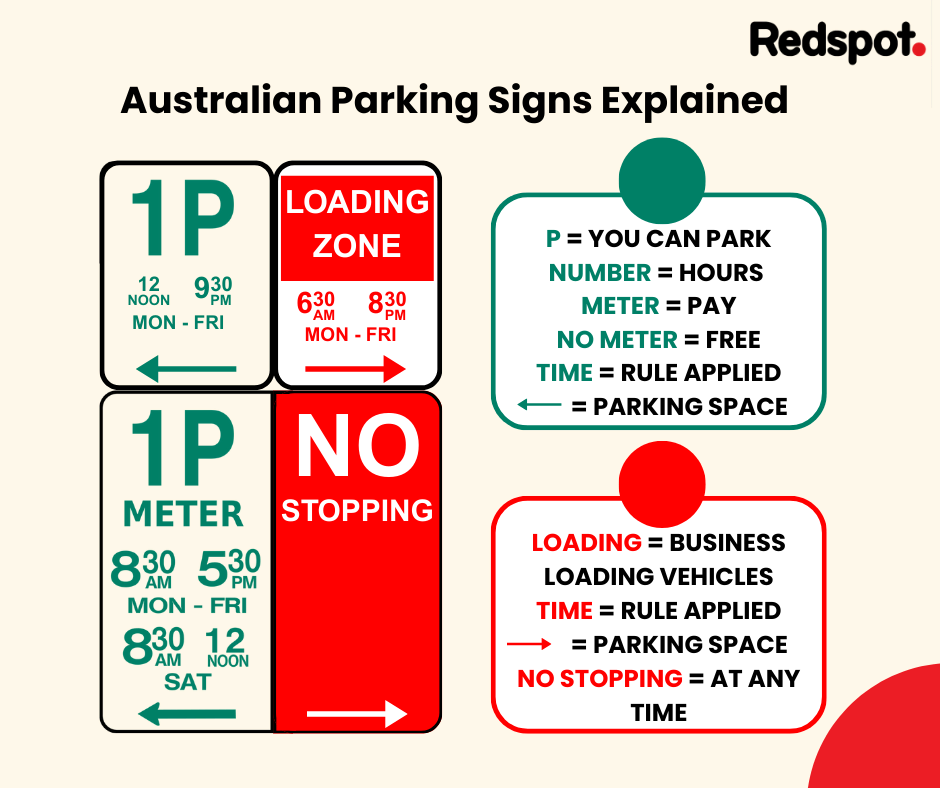
To help you get your head around parking signs, so you can park safely in a Redspot vehicle, we have broken down a typical parking sign. In general, when the letters are in green, they mean:
- P: You can park in the zone indicated.
- Number: The number of hours you can park.
- Meter: You must pay to park here, but only for the hours permitted.
- No Meter: If the sign does not indicate a meter, then you can park for free for the hours permitted.
- Time: This is the time this rule is applied for. So if it states 2P, 12 noon – 9:30pm, Monday – Saturday, then you are able to park here for 2 hours only between the hours of 12pm and 9:30pm between Monday and Saturday. Any time out of this, including Sunday, there is no restriction on the amount of time you can park here.
- Arrow: The direction you are allowed to park. There will usually be another sign or road marking confirming where this parking rule ends.
If the sign is red, the rules could mean:
- Loading: This is a loading zone intended for commercial use only, such as tradies, restaurant deliveries and shop stock unloading. If you are not loading or unloading anything, then you should not park in this zone, as you may get a heavy fine.
- Time: This is the time this rule is applied for. So if it states 5:30am – 12:30pm, Monday – Friday, then you are unable to park here during these hours, unless you are a business loading your vehicle. Outside of these time zones, no restrictions apply, and you can park here.
- NO STOPPING: At any time, you should not park here.
- Arrow: The direction the rule applies to. There will usually be another sign or road marking confirming where this parking rule ends.
How do toll roads differ in Australia from those in the US?
Both Australia and the United States have an extensive network of toll roads, which offer faster and more convenient routes. Toll roads can differ in each state in the US, and some still operate with older cash booths, meaning drivers need to carry change and stop to get through. Comparatively, Australian toll roads are now completely cashless, making it easy for any visitors to tackle. You should be aware of some key facts:
- Toll roads are conveniently cashless and electronically tolled.
- Fees are either collected through a toll road e-tag fitted into your car or by manually paying online each time you use a toll road, using your registration plate as the identifier.
- Most toll roads have a fixed fee, which is great, but some do operate with a charge per distance or a variable fee during peak times.
- Don’t worry about getting an e-tag for a car rental, as you may be accidentally charged twice through both your e-tag and the car rental company. Instead, it’s best to pay for each toll road charge through the Linkt website or app. Just like many US companies, Redspot also offers a toll road waiver add-on, so you can pre-pay for toll roads. Too easy.
How similar is outback driving to desert driving in the Western US?
Outback driving and US desert driving in the American Southwest can feel similar in terrain and climate. The biggest differentiator is that the Australian outback can seem more remote with fewer service stops. So, it’s no surprise that we get asked a lot of questions about driving in the outback.
Outback driving in Australia
- Speed limits: Typically around 100-110km/h on the main highway roads, and can be reduced to 50km/h when passing through tiny outback towns.
- Traffic: Generally low traffic, you can drive for many kilometres without seeing a single soul. Top tip: it’s customary for drivers to give a little hand wave when they pass each other on a rural outback road. Say g’day!
- Road conditions: A lot of work has been done to seal the roads in the outback, particularly on the Red Centre Way from Darwin down to Uluru. However, similar to desert driving in the US, many outback roads are unsealed and may require a 4WD. When driving in the outback, be prepared for red dust, uneven ground and high temperatures. Roads are often unlit, and we strongly advise against driving after sundown.
- Hazards: Wildlife is more of a hazard on the road in the outback, compared to the deserts in the US, particularly at dusk or dawn. The extreme heat can be dangerous in the summer months, and sometimes a dust storm can cause the red dirt to swirl in front of the windscreen.
- Road trains: Huge “road train” vehicles operate in the outback and can be quite intimidating to see. Drivers should always be incredibly careful when overtaking the extra-long vehicles.
- Navigation: Signal can be poor in many outback areas, and you may not pass a road sign for many km. Always download a map for offline use or use an old-school paper map for extra peace of mind.
- Fuel: Petrol (or gas) stations are sparse, and you may often see a sign warning “no fuel for 100 km”. It’s recommended you fill up at every fuel stop and never let your tank get low.
- Planning for the outback: Plan your route in advance so you know the terrain, stops for fuel (for both the vehicle and humans) and weather conditions. Always pack extra water, emergency gear, and reflective clothing. Consider a satellite phone for off-road driving. If you are heading into the outback then let us know, our branch staff may just have a tip or two.
- The hidden gem of outback driving: Similar to the US, Australia loves a roadhouse! In the outback, they are iconic and quintessential Australian, where you can grab a bit to eat and top up on fuel. Some even offer live music and accommodation. One of our favourites is The Daly Waters Pub between Darwin and Uluru, which offers a huge campground, food and live music most nights.
Aussie Tips
Dan Mekler founded Redspot over 35 years ago, and his family still run the company today. What he loves most about driving in Australia is the wide open roads in the outback. However, the most challenging part about driving here is the amount of wildlife that can run or hop out on the roads.
“What I love most about Australia is the magnificent Australian outback. Some of Australia’s greatest attractions are its vast and beautiful outback and its wildlife.
Dusk to dawn can be the most dangerous time of day to drive as the changing sun can make it harder to see wildlife. Animals can be confused by car headlights travelling at speed towards them.
Pay attention to road signs showing images of animals ahead, such as kangaroos, wallabies, wombats, and livestock.”
-Dan Mekler, Managing Director of Redspot.
Car rentals for US drivers – Rely on Redspot
Driving is the ultimate way to experience an Australian holiday. Many locals and visitors plan awesome road trips each year. From stargazing in Uluru to ticking off all the iconic roadhouses through the outback, nothing beats the freedom to choose when and how long you stop for.
Whether you want to try to complete the “Big Lap” around Australia in one go or plan multiple holidays to fully explore every State completely, we say just do it! Luckily, our renting guide breaks down all the licence, road and renting rules so you can jump behind the wheel with confidence.
With one-way rentals, we make it easy to choose your own itinerary without having to fit a return trip into your schedule. Simply fly into any major airport, including Sydney, Brisbane, Melbourne or Perth, and pick up a clean and reliable car hire from Australia’s largest family-run car rental company. Hell yes!
FAQs
How long can you drive on an overseas licence in Australia?
In general, you can drive on an overseas licence for up to 3 months, depending on the state you reside in. If you plan to stay in Australia longer than a holiday, you will need to convert to an Australian licence to continue driving.
Is it a good idea to rent a car in Australia?
We may be biased, but hell yes it’s worth it! Take your schedule into your own hands, stop for as long as you like at any breathtaking landscape and enjoy the quintessential little Aussie towns you would miss on a plane or bus.
Does my US car insurance cover me in Australia?
Your US insurance likely only covers you in the US and Canada. Luckily, car rentals in Australia include basic insurance coverage by law, so you are always covered. You can also upgrade to reduce your excess.
What is the maximum age to rent a car in Australia?
There is no legal maximum age to rent a car in Australia. However, some car rental companies may require additional documents, such as a recent doctor’s certificate.
Redspot only requires a full, valid driver’s licence, written in clear English.
What side of the road does Australia drive on?
Australia drives on the left-hand side of the road.
Can you overtake on the left in Australia?
No, you overtake on the right-hand side of the road in Australia.
What should you do if you hit a kangaroo in Australia?
If you unfortunately hit a kangaroo in Australia, make sure you can pull off the road safely and turn your hazards on. Only approach the animal if it is safe to do so. Do not attempt to do this on a road with a 100km speed limit.
If the kangaroo is alive, do not move it and contact the local wildlife rescue or emergency services. If the kangaroo is dead and you can, move it off the road to prevent any further accidents.
If you hit a kangaroo in your Redspot car, check for damage and report the incident so we can complete a further inspection.
Am I allowed to drive on a US learner’s or intermediate licence in Australia?
You cannot drive on a US learner’s or intermediate licence in Australia. You will not be permitted to drive on a holiday in Australia. However, if you are moving temporarily or permanently, you can convert to an Australian licence and complete the learner and provisional stages to obtain a full licence.
What documents do I need to rent a car in Australia?
You will need:
- Your full, valid driver’s licence, in English or with an official translated copy.
- A credit card in your name.
- Some car rental companies may also need a secondary document with your address on it, such as a utility bill, to confirm your identity.
- Some Australian car hire companies may ask to see your passport.